nave-xai
Concept explanations of vision, time-series and text encoders.
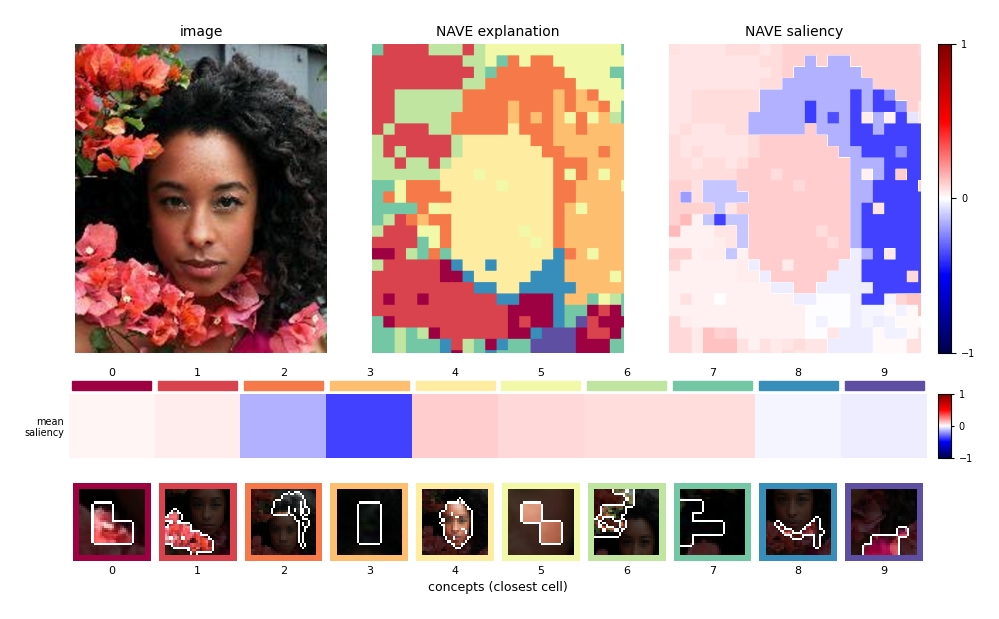
Which concepts does a vision encoder extract, and where? nave-xai is the official package of NAVE, from Multi-depth Concept Extraction for Post-Hoc Vision Encoder Explanation (ECML PKDD 2026), with Samuel G. Fadel and Sebastian Mair. NAVE combines the activations of a frozen encoder at several depths, extracts concepts from them without supervision, and maps them back onto the input: an explanation of the encoder itself, before any classifier.
- Images, time series and text:
NAVEImage(CNNs and ViTs),NAVESeries(1D CNNs, transformers) andNAVEText. - Ready to use: a ViT-Ti/16 and ResNets built in, no PyTorch needed; your own PyTorch or ONNX models too.
- Summaries: explanations with uncertainty, saliency and concepts’ correlation with the predictions.
- A GIMP plugin: NAVE superpixels in GIMP 3, Filters › Generic › NAVE Superpixels…
pip install nave-xai
PyPI · Code on GitHub · Documentation · Paper · GIMP plugin
Try it in your browser
All 22 notebooks open in Google Colab and installs what it needs in its first cell (a Google account is needed; the training notebooks are best run with a GPU: Runtime › Change runtime type).
Getting started
| Notebook | What it shows | |
|---|---|---|
| Demo | A tour: explanations, depth, concepts across images, summaries |  |
| Time series | A 1D ResNet on smartwatch motions: segments, snippets, profiles | |
| Text | spaCy’s encoder and a topic classifier on Reuters news | |
Animations
| Notebook | What it shows | |
|---|---|---|
| Encoder blocks | A ViT or a ResNet, block by block, with UMAP, explanation and saliency | |
| Training | A ResNet34 learning Imagenette, checkpoint by checkpoint | |
| Augmentation | Does the explanation survive rotation, zoom, colour shifts, noise, blur? | |
| Supervised and self-supervised | ImageNet against DINO training, for ViT-S/16 and ResNet50 | |
| Image atlas | UMAP of the tokens, as points and as the patches themselves | |
| Artifacts | The high-norm tokens of ViTs, and how they relate to the other concepts | |
| Shortcut | A mark on one class: a model trained with it and one without | |
| Fine-tuning | An ImageNet ResNet34 fine-tuned on satellite images, with CKA per block | |
| Overfitting | Few images of two classes: a training image against a validation image | |
| Imbalance | One class ten times rarer: how many concepts each class gets | |
Inspecting models
| Notebook | What it shows | |
|---|---|---|
| Training | Random, supervised and self-supervised weights of the same architecture | |
| Architectures | ViTs and ResNets on the same photo, and how similar their decompositions are | |
| Depth | Where information is compressed, block by block | |
| Registers | ViT artifacts with and without registers (DINOv2) | |
| Shortcuts | Measuring whether a spurious cue takes over the explanation | |
| Concepts as features | Classifying images from their concepts’ proportions | |
| Localization | Boxes around objects from NAVE’s regions | |
| Uncertainty | Where the encoder hesitates | |
| Causality | Do the concepts that come with a class drive its score? Interventions in a ResNet50 and a ViT | |